Magic Back to Town
.
Magic Back to Town .
Curator/Production Director: Chiarina Chen
Featuring:
Moon Ribas
Closca
Lizzy DaVita
Emilie Weibel
Jason Nazary
Nathaniel Flagg
Bryson Rand
Kate Ruggieri
Stage Manager: Will Jennings
Sound Tech:Jason Zinx
Cornelly Theater, New York
With Support of Cyborg Foundation
Posthuman Research Group, NYU
New York Institute of Technology
A Note on background


Since the beginning of the project, we have collected human audio stories about their feelings of disconnection and thoughts of magic. These narratives have been transposed into live-improvisations on the scene by musicians Emilie Weibel and Jason Nazary. Audiences immediately entered a sonic landscape where stories were told in multiple languages. Moon Ribas joint another force as she turned on the magnet in her elbow, waiting for real-time earthquakes. The perceived seismic data got synced with human acoustic soundwaves, live-remixing by the musician.
Moon Ribas and Closca's piece The Earth Beat explored how technology could connect us and interact with our natural surroundings, highlighting the unpredictability of nature and its overwhelming force, making humans powerless and vulnerable.
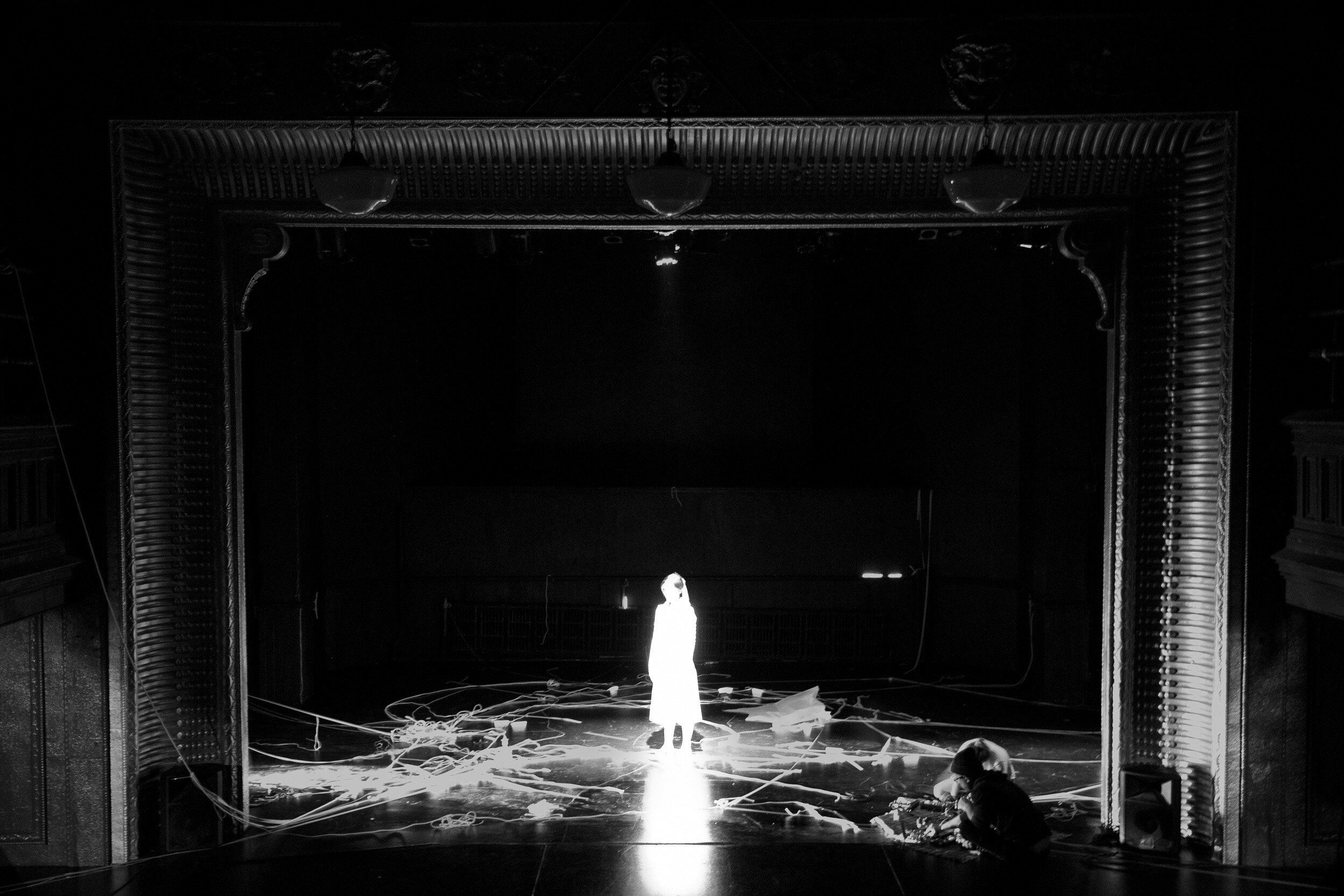
Lizzy DeVita performed an anthropologist in limbo who recounts his memories, dreams, and regrets, as a web of connections is spun around him, addressing distance, proximity, and how we see others.
Waiting Earthquake performed the real-time earthquake waiting process, live-sonic accompanied by Emilie Weibel and Jason Nazary.
This project started with my conversations with cyborg artist Moon Ribas that took place in New York, Barcelona, and online. At the time, I was working on the Collecting Anxiety series, reflecting on the predicament of being the modern individualistic 'self', disconnected from the ecological web. As she shared with me her own anxiety and how she heals through becoming a cyborg, we felt the urge to collaborate on a project that addresses the limitations and vulnerabilities of humans while exploring paths of becoming cyborgs.
Ribas implanted a magnetic sensor in her elbow that is connected to seismic meters, allowing her to feel earthquakes in real-time. According to Moon, becoming a cyborg has been a process that brought her back to nature on a daily basis. "Every day, I felt two heartbeats, my own and the earth's beat," she said. Sensing the earth's movements allows her to feel the vulnerable and disconnected side of human beings while gaining healing power through the interconnection with more-than-human entities.
Her embodied cyborg living echoed Donna Haraway's classic 'A Cyborg Manifesto', in which she emphasized that the concept of the cyborg was a rejection of rigid boundaries, notably those separating "human" from "animal" and "human" from "machine." The non-dualist hybrid was also reminiscent of Braidotti's posthuman nomadic approach, stressing the becoming of multi-subjectivity and 'transversal alliance across species.' Hence, grounded upon the shared exhaustion of modern society and disconnection from nature, we want to summon 'magic', re-enchanting the alliances across human, ecology, myth, and machine, exploring new subjectivities and potential ways of connection.
In this project,
we explicitly highlighted:

1.The alliance between women and nature. Women and nature have historically been aligned. Both have been exploited, colonized, and controlled by patriarchal systems. By foregrounding the cyborg body and eco-psychology, we re-animate and empower the once-oppressed linkage.
2.Clearing out our standpoint in posthumanism rather than transhumanism. Transhumanism refers to an approach in which humans are centered, and the progression of technology only enhances the human's dominant role. This approach has been popularized for the last decade by 'stars' like Kurzweil and Elon Musk (examples like immortality and consciousness uploading). Posthumanism, however, is about the shifts away from the human-centric role. Technology here is neither the "other" nor a fancy human-enhancement tool, but an inseparable part of our relational systems that enables us to gain a deeper understanding of the world.
3.Magic as an ontological system that incorporates the invisible, the nonhuman entities outside of the Euro-centric system. As Silvia Federici said, "At the peak of the 'Age of Reason' - the age of skepticism and methodical doubt - we have a ferocious attack on the body and revulsion for the female body and its association with nature..." The return of magic stresses a constitutive sense of intimacy with the world and a sense of "entanglement in a web of immanent and ever-shifting relations and perpetual becoming." (Rosi Braidotti)
To captured the sense of magic, I specifically set the show in the 19th century Connelly Theater among hundreds of theaters in New York, a place where people still light up the 'ghost-light' every night after the show, protecting the theater from phantoms in the darkness.
Gathering cyborg artist Moon Ribas, scenographer Closca, musicians Emilie Weibel and Jason Nazary, performance artists Lizzy DaVita, Nathaniel Flagg, Bryson Rand, Kate Ruggieri, theater artists Jason Zinx, Will Jennings, we developed the program as a set of synchronized theatrical performances.