A Year of Playing Shan Shui Basketball
Chiarina Chen
This is a commissioned essay for the book Floater: Blurring Basketball Lines
Day one
I never thought I’d pick up a basketball again in my life.
Not until Oct 19, Sunday, 10:30am, Columbus Park, Chinatown.
I was sitting by the side court, alone.
This is stupid. I thought. Why am I even here?
It could have been one of those moments where you take someone’s “join us sometime” too seriously and then panic.
The person who said that to me was Lu. We knew each other way back and reconnected last year for a show I curated in a micro black-box theater. Lu had killed it. She took us into a dreamscape that drifted across worlds and grounded in nowhere. We were all inside it, meandering, half-awake and half-dead, as if we’d crossed over to the other side of the living. Perhaps it was that intimate dream-walk, or perhaps it was the karaoke we did later, with Lu, Herb, Connor, and Dustin, that ‘lured’ me in. So when they said to me,
“Come hoop with us,” I took it seriously. It felt like a spell, if not a call. And I answered it right then and there.
For someone who’s never properly trained, only wildly played way back as a kid, it’s quite scary to play again at this age, with strangers, and insert myself into new groups of people.
I checked my phone obsessively, hoping Lu and herb could come sooner to ease my anxiety.
Basketballs were dropping like drumbeats. My heart beats with them. I noticed my body starting to tremble. I took a deep breath, stood up, and walked to one of the courts where some folks were shooting randomly.
“Can I join to shoot some balls?” I faked a relaxing tone.
“sure” a guy said without looking at me.
I picked up a basketball. In a split second, a tiny current flushed through my fingers then quickly disappeared. I froze for a moment. Then I turned my head to the rim and threw it without thinking. My eyes followed the arc in slow motion.
Please.
It hit the rim and bounced out. I ran to the ball, pretending it was all cool, avoiding eye contact. Picked it up and shoot again.
Not in.
Just keep trying. No one noticed you anyway. Be cool. Don’t make eye contact. Just make one shot. Just one shot, Chi.
Bounced out again. The ball dropped like the stone thrown on a lake - waves spread then vanished.
“You need more practice,” Someone picked the ball and said.
What—the—fuck. My blood raced, my veins boiled. Do I know you? Who the fuck are you to tell me I need practice? Of course, I know I need practice because I haven’t fucking touched a goddamn ball in over a decade.
“Well, I haven’t played for a long time,” I replied, pretending I was chill about his comment.
I was not.
Obviously, I was over-reacting like a five-year-old.
He might have been a nice person, just throwing out a comment like he would to any random guy. Later, I learned he wasn’t a bad guy indeed. But for some reason, on that first day, I felt ashamed. Like it was all my fault, and it was all a mistake to be there in the first place.
The thing is, we get triggered only by things we care about, not things that we don’t care. Even if we don’t realize we care, we get triggered. And that’s when you know you do care.
I wouldn’t be so defensive and upset if it were just any other sports that I was not so good at. I’d laugh it out. I’m never a sports person, and my body is as inflexible as you can imagine. But I realized I got upset because it was about basketball. I was upset that I used to play in my hometown and stopped after moving to New York. I was upset that I couldn’t make a shot now, in a place that’s not my hometown, where I used to make shots.
I was upset about how distant I had become from basketball and from the person who once able to play basketball and made those shots.
Just as I was about to retreat, I saw Connor walking toward me with a big, gentle smile.
“You are good at dribbling!” He said to me.
Dribbling?
The question mark in my head showed how long it had been since I played. I hadn’t played in so long that I didn’t even know the vocabulary in English. Throughout my nearly a decade in the US, doing what I do, there hadn’t been a single time when I needed to use the word “dribble.”
He showed me what a dribble was, and my Chinese vocabulary clicked right away. Dribble, 运球. Of course, I know what 运球 is. It means continuously bouncing the ball with one hand while moving.
-
As the word 运球came back to me, I felt a sense of ease and relief, like I was grounding myself by greeting an old friend.
“Wanna do some layups now?” Connor asked.
Layup, 上篮. Another old pal I remembered.
I did it. The ball went in. It felt great.
For the first time in years, I felt my body unblocked, like something was flowing inside me. I sensed a warm, fluid stream running through my blood, soon vanished in the air.
Lu and Herb finally arrived.
Later they told me that Sunday marked the first day of Sunday School at CBC.
Blank Space 留白
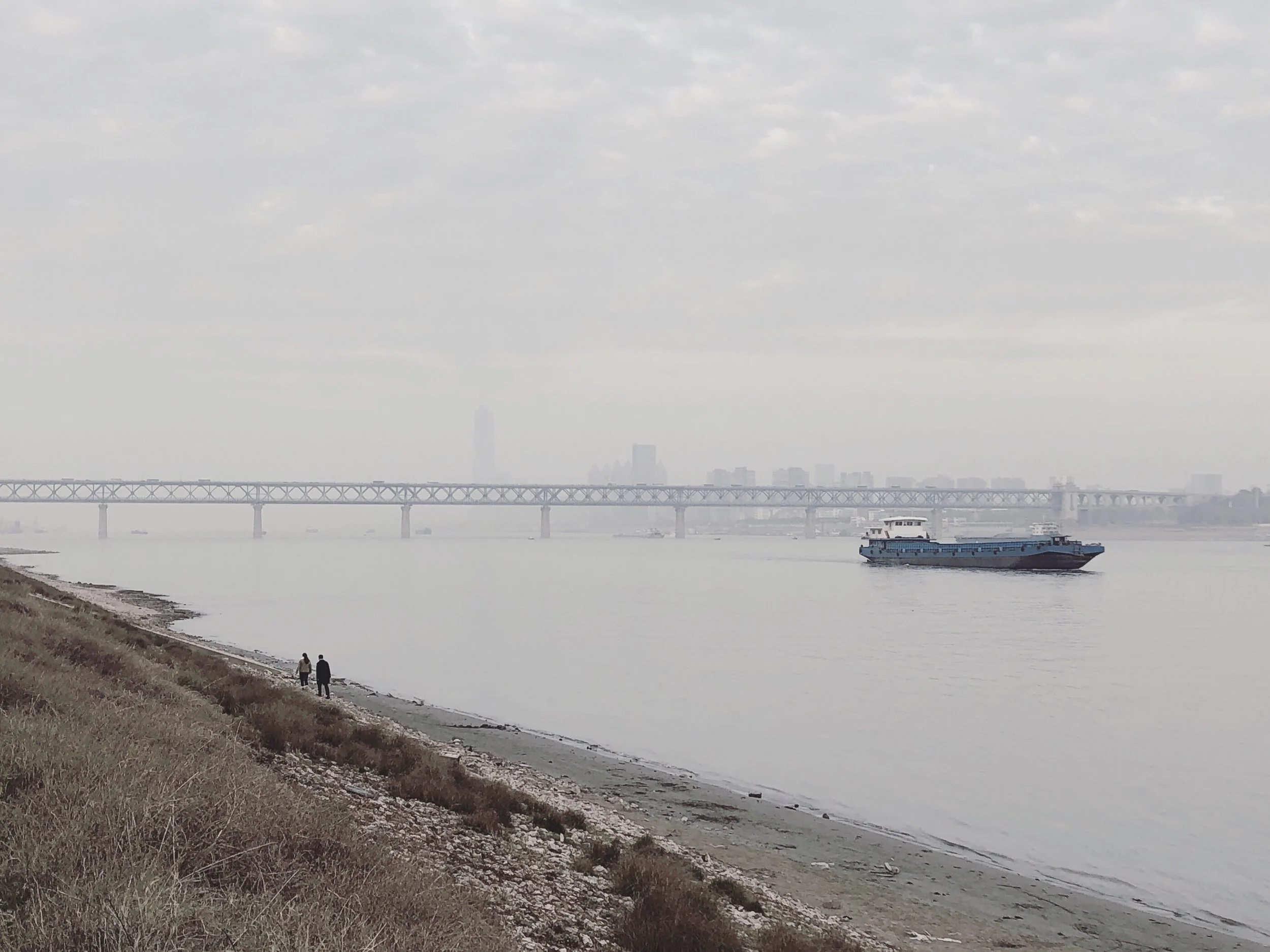
The place I was born is called Wuhan — a city nobody heard of until COVID.
It’s sad to see how a hometown can be reduced to an epicenter. It used to be so much more. When nobody knew about it, I used to describe it to people as freely as painting on a blank canvas.
You know, it’s a city by the Yangtze River, with scorching hot weather, incredibly delicious hot-dry noodles, and the myth of nine-headed birds (九头鸟), known for their equally fiery temper and aggression. You can imagine growing up there with tremendous energy among the people, the sharp-sounding dialects, the sticky heat, and surging hormones. Side by side with this massive, restless river rushing through our lives every single day.
And that’s where I grew up as a kid, picking up a basketball and hooping in the wild.
Back then, the basketball court was truly a wild place. From elementary school to middle high, the education system was rigid and relentless. Studying was the only thing that mattered. Everything else was seen as a waste of time, discouraged if not outright forbidden. There were no indoor gyms, either. The playground was the only space for everything.
These parameters shaped my early sense of basketball. It was always outdoors, full of uncertainty, almost rebellious when you consider the stereotypes—good students study indoors, bad ones play basketball outside. Boys play basketball; girls don’t. We broke all those rules. We didn’t give a damn about these standards. We mixed—boys and girls, good students and the bad. All of us did well at school, but none of us followed the ‘good’ rules. None of us were particularly skilled at basketball either. We were all equally mediocre, but we had boundless energy to spare.
Playing basketball at that age wasn’t about skills; it was about guts, impulses, and being each other’s strength in an open, wild public space. And, perhaps, love?
I ended up dating a boy from the same group. The teachers at the time were neurotic, obsessed with catching ‘young loves (早恋).’ Because of them plus the heavy schoolwork, we barely had any one-on-one time. It was always with the gang, hooping together whenever we could. Sometimes after the sunset, we’d go to my grandma’s house to eat noodles. He’d told my grandma that he planned to go to the same university with me in the future. I remembered on the balcony, grandma’s velvets always blooming.
Two of the most cliché things happened in my teenage years. First, my first kiss took place on a basketball court. On a rainy day. (I know)
It was the day before I left for another city to attend an international high school, and he snuck out to see me. It was such a bad kiss. Neither of us knew how to do it properly, and the rain made it worse. I couldn’t tell the difference between tears, lips, and raindrops. It was all a salty mess.
The other cliché was that his mother hated me. When she found out about us, she forbade him from ever seeing me again. And that was that. It ended things between us and, in a way, marked the end of my time with basketball and my days in Wuhan.
They sound too stereotypical that I don’t even want to admit none of these ever happened. But maybe clichés are clichés because they do happen. Again and again in mundane lives.
No matter how many times they happen, these are my clichés.
Mine.
My vulgar, powerless clichés.
Lu. Perhaps you know what I mean?
Perhaps only you would understand.
Those were the years before I went to the US for college. Before English crept up on me and took over my schizoid brain. Years before I entered the art world and devoted to personal ambition. Before adulthood. Before any real relationships. Before I got exhausted by careerism, nonstop projects, the labyrinth of identity. Before Facebook. Instagram. iPhone. Before the word ‘Fuck’ and ‘Fucking’ filling the sentences in my head when I’m mad. Before my grandmother died.
Those were the years before my diaspora.
Looking back now, I am still amazed how intuitive and fearless I once was.
Why is it that the farther we go in this world, the more we are constrained by invisible boundaries? Why is it that the more knowledge we acquire, the more trapped and fatigue we feel?
Shan Shui 山水
I started going to Columbus Park every Sunday.
Recalling the anxiety of my first day at Columbus Park feels like a prolonged jet lag. That dizzy, doubting moment has certainly turned into one of the most treasured points of return in my diasporic life.
Memories vaguely flooded back each time I dribbled or took a shot: the sticky afternoons in Wuhan, our little ‘gang,’ grandma’s noodles, the fierce desire to win…
Things that had been absent for the past decade started to re-emerge, bit by bit.
My body, too. I used to be harsh on it, now I let it guide me. It’s as if a code has been deciphered. I can feel the basketball sets it free, and it remembers everything from the past. Things I thought had been disconnected for so long turned out to have always been with me.
They just exist in a form of absence.
Like a blank space in a Shan Shui painting.
You see, basketball, in its purest form, can feel like a living landscape—a dance of motion, energy, and flow that resembles the timeless principles of Shan Shui (山水).
山水(Shān shuǐ), literally meaning mountain and water, refers to Chinese landscape painting and the philosophical, aesthetic idea of depicting natural landscapes. In the view of the ancients, “mountains and waters” are not merely static entities, but idealized spiritual worlds that reflect the harmony and vitality of the universe.
山,宣也。宣气散,生万物(《说文》)
Mountains (山) signify ‘xuān’—to disperse and radiate energy, spreading vitality that gives rise to all living things. (Shuowen Jiezi)
Mountains are the source of the earth’s vital rhythm, where the energy of the land (地气) is channeled and released. Only through the presence of towering mountains can the earth’s energy be emitted, spreading in all directions to foster and nourish all life. Water on another hand, just as 上善若水 (The highest good is water) described, marks the source of harmony, balance, and potentiality.
Rooted in Daoist philosophy, at the heart of Shan Shui (山水) painting lies Xie He’s concept of 气韵生动[1] (qì yùn shēng dòng), often translated as “rhythmic vitality”. 气 (qì) stems from the mountain and permeates all things. It is the invisible current that animates the mountains, rivers, trees, and clouds depicted in a Shan Shui painting. 韵 (yùn), on the other hand, summons harmony like water, bringing equilibrium between mountains and rivers, fullness and emptiness, yin and yang. Without capturing the qì yùn, a painting would feel lifeless, no matter how technically skilled the artist.
If we think of playing basketball in the world of Shan Shui, you can feel that 气 (qì) flows through every dribble, pass, and shot, animating the game with vitality. 韵 (yùn)—the rhythm and balance—emerges in the seamless coordination of players, the timing of movements, and the grace of the ball’s trajectory. The pauses and silences, like the blank spaces in a Shan Shui painting, subtly create a dynamic cadence of motion and stillness.
In A Thousand Plateaus, precisely the sixth plateau, it came to my surprise the way Deleuze and Guattari wrote about such vitality and Taoism, especially the connections to Body without Organs (BwO). They wrote so passionately that the whole chapter reads like a live game. The ‘body without organs’, they propose, is not a fixed entity but an ongoing process and something you continuously ‘make’. It embodies a state of openness and potentiality, just like Taoism, which allows new existences to be configured. And true vitality, is like love, lies in active experimentation, breaking free from rigid ‘organisms’ and allowing desires to flow in ways that challenge conventional structures.
Shan Shui Basketball is much like this. It’s a site of experimentation where players move beyond the rigid categorizations. Here, one doesn’t simply ‘execute plays’ but steps into a state where movements arise intuitively, constantly responding to each other’s impulses and desires. A fleeting transition, a glance, an unspoken connection… No one is a fixed ‘self’ anymore but relational and, yes, desiring beings.
That’s why to me, Shan Shui is never some transcendent or mystical existence, but always a grounded way of living. Situated and embodied.
Once, Lu and Yulin said to me after a scrimmage, “Chi, you are such a competitive player. Aggressive too! Haha.”
Ah. Is that so? HAHA!
I laughed like a five-year-old again.
Maybe it’s all that ‘hot’ energy running through my blood since day one. The hot-tempered nine-headed bird, the dry spicy food, the unbearable heat on the playground. They used to flow side by side along the Yangtze River. Now, I feel that fiery Qi coursing back through my life again.
Maybe this is my kind of ‘competitiveness.’ It isn’t about becoming the strongest by meeting established standards. Even if I’m the one who least fits those so-called ‘standards’—short, small, amateur Asian woman—I still play. I play no matter what. This type of competitiveness isn’t about proving to anyone that I fit the mold, but about refusing to be limited by it.
As long as I’m playing, I can feel that each of us is so much more.
Much, much more.
I see us in vibrant landscapes, where the absence has always been in confluence with the current moment. Our desires move freely, not as a lack to be filled (as those psychoanalysts love to claim) but as an affirmative force, as the Qi dispersing from the mountain. And those ruptures, cliché blockages and broken moments in life, are meant to be part of it. They are the blankness that holds its weight through the passings of space and time, the thresholds waiting to be transformed into the Rhythmic Vitality once again.
In my years living in the US, I’ve always felt like I was on an errantry between worlds. Alone. Displaced. Longing for an anchor that grounds me in this country. But in these Shan Shui moments, I feel the urge again, a sense of lightened freedom, to pull up the anchor and cast it away.
One recent afternoon, after a string of meetings, I found myself in Chinatown. I wandered back to Columbus Park and sat by the side court again. Arcs of shots rose and fell. Some elders shuffled by. For a moment, I thought of my grandmother, the velvet on her balcony, clichés, some faces I can no longer return to. I also thought of faces I just saw last Sunday and those I will see the next.
Then, an indescribable feeling struck me—absence and presence merged in front of me like a scroll of painting unrolling. The riverbanks of Wuhan and the concrete courts of New York, flowed as one.
And for now, that is enough.