What’s in a Name, Anyway?
Chiarina Chen
It’s pretty random when I say my name. Nowadays I go by Chiarina most of the time. But sometimes, only sometimes, when I meet certain faces, I say “my name is Chi.” I leave it to randomness and immediate impression because it’s hard for me to draw a clear line between where or to whom I’m Chiarina and to whom I’m Chi. On paper, for consistency perhaps, I’ve decided to use Chiarina Chen throughout. But when it comes to people. I let them decide.
The name Chiarina came to me later in my college years, and it was out of a simple drive: white people kept calling my name wrong.
When I first came to the US for college in 2010, it was just Chi. And my first cultural shock was to being constantly called “CHAI” like Chai-latte. Gosh believe me, it was such an awful sound. It was like calling a fat cow. (no offense to any cows but you know what I’m saying) In the big lecture room, the professor would call out my name, using a microphone and amplified by the speaker, “CHAI— is CHAI — here?“ When no one replied, he’d repeat again.
Starbucks was even worse. Every morning. Among droopy faces, there was always an enthusiastic staff member yelling my name: “CHAI. Your latte is ready! CHAI? Where’s CHAI?“
✦
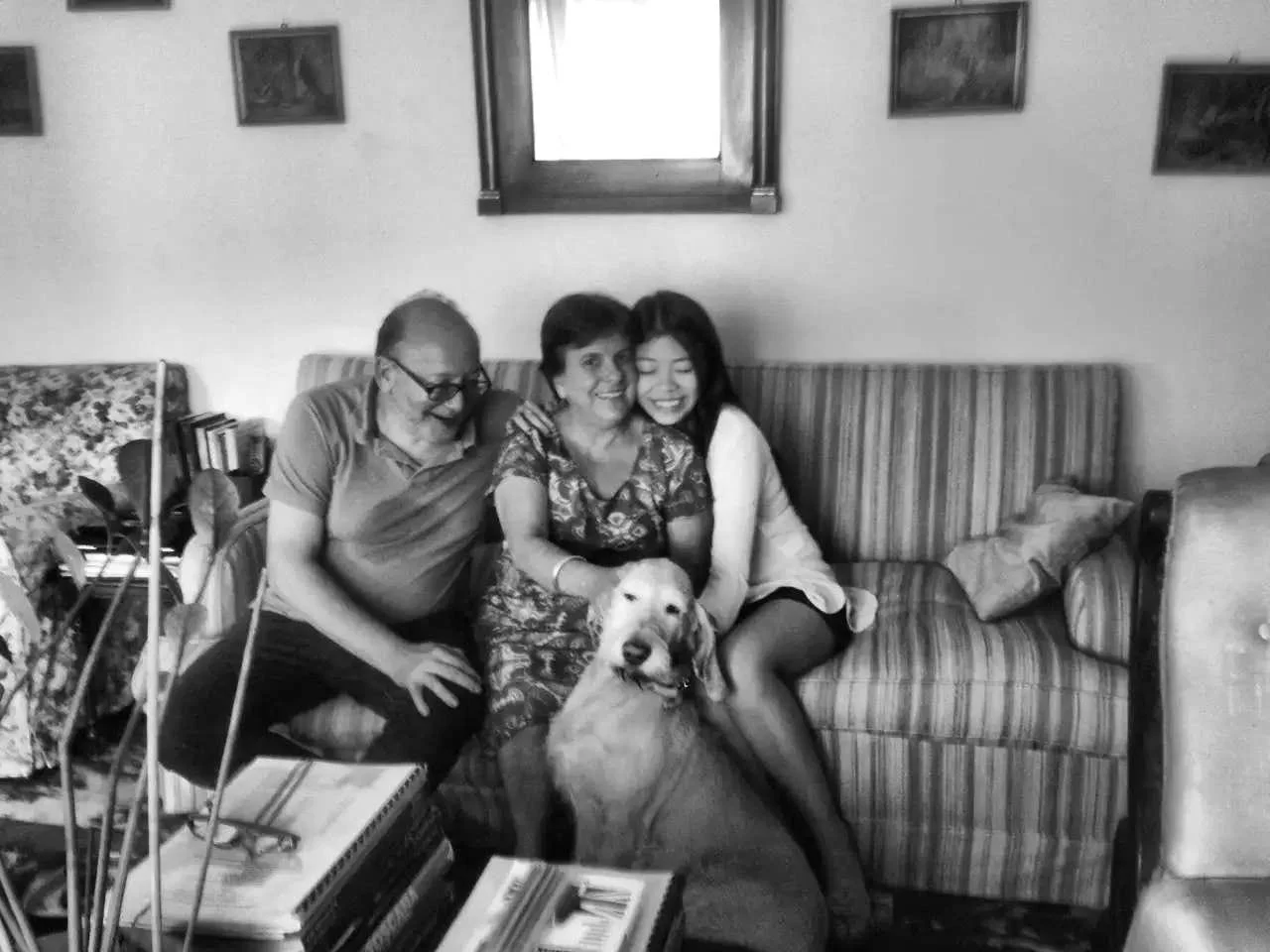
The name Chiarina found me, or I found Chiarina, during my exchange semester in Florence. I was staying with a Florentine family whose names were Geraldina, Giovanni and Titta the dog.
Geraldina is a masterful cook. I never met anyone again, even to this day, who is more magical than Geraldina. Since she had spent decades in Paris, her passion stemmed from French cuisine, and soon grew into her own unique style of fusion and creation. For her, cooking is a way of traveling, a way to bring the world to you. During my almost eight-months stay, I never had a repeated meal.
Geraldina speaks perfect English and French, while Giovanni speaks only Italian. In the first month, before my Italian lesson started, we could barely communicate, except through playing the Guitar. For some reason, I liked those days. It was filled with silence and a genuine sense of awkwardness. The untranslatable, opaque air in the room granted me moments of peace and belonging I had never experienced before.
The absence of language can be a great foundation for relationality. Anything comes after only feels light and natural. A few months later, we were able to communicate a little bit more. I was doing research on my thesis about medieval art from the Black Death period and early renaissance, and to my surprise, they had so many related firsthand materials and access to the old archives that constantly blew my mind. Later I learned that way back in the history, her great-aunt was the wife of one of the Kings.
The days in Florence were a surreal period of my life. All I did all day was go to classes, field trips, libraries, endless art seeing and wanderings on city streets. I never felt home since 16, the year I left my hometown. And my stay with Geraldina, Giovanni, and Titta, the mundane routine, the expectations for each meal, the stress-free, fragmented conversations, made me feel at home. I know they felt the same.
When summer slowly arrived, it was almost time for me to leave, too. I recall that sometime before then, on a random afternoon, Geraldina asked me if I liked the name Chiarina. I must have mentioned to them before that I wished to have a longer name so people don’t keep mispronouncing Chi.
Chiarina. Bright, luminous. Guess what. It has C-H-I in it, too. It’s perfect.
Giordina told me it was Giovanni’s idea. After a few months spent together, I had become more and more like a Chiarina to them. And I liked that.
On the day I left, after packing all my luggages, Geraldina and Giovanni helped me get my things downstairs in that fancy, narrow, slow lift.
I suck at saying goodbye. All kinds of goodbye. That’s why I only do breakups over texts. I know. It’s pretty bad.
Before getting into the cab, I turned around and hugged Geraldina, with tears in my eyes. She patted my head,
“Take care, my Chiarina.“
I’m not writing this whole thing to show how meaningful this new name is. It’s not why I kept it. To me, it carries no meaning. No meaning, but memories. And that means something. That’s all.
✦
Many years ago, at Pioneer Works, I had an argument with a Black woman about names and identity. It was during a group show of artists from Port-au-Prince. We met on site and had a great conversation about art and diaspora. Suddenly, as we were exchanging contacts, she asked, “Why is your name Chiarina? Is that your original name?” I was a bit startled. “What do you mean? It’s just my name.”
“But don’t you have a Chinese name?” She then showed me her name and said it was in the language of her ancestral tribe.
“Oh. That’s great for you. My Chinese name is Chi, but nowadays I go by Chiarina.”
“What?!” She looked shocked. “Why don’t you keep Chi? It’s a beautiful name. A name represents our roots and identities. It shows who you are and connects you to your ancestral land. Why would you create a new one?”
“Well. I respect that you think that way. It’s just that, for me, I don’t believe my identity is limited by what I’m called,” I said lightly but firmly. “If I’m secure in who I am or what I’m becoming, I don’t need to be fixated on a symbol — say, a name. I can be both Chi and Chiarina.”
“That still feels like you’re giving up your identity.”
“Quite the opposite. It’s always been with me. I just let it grow.”
The tension was getting a bit smoky. I completely understood and respected how she honored her name; however, her righteousness didn’t make me wrong. I knew I was right, too. And my firmness made her persuasion a feeble attempt, which clearly frustrated her.
My friend Liam, a sweet white guy who had been silent the whole time we were arguing, finally felt the need to mediate. “Well, that’s a great discussion, and I think you’re both right. Shall we move on and grab something to drink?”
To this day, I still remember that moment — two people stubbornly holding on to things that were neither right nor wrong, but genuinely true to themselves.
Is calling myself Chiarina a betrayal to my Chinese identity? Is there ever pure Chineseness? Does Chi make me ‘authentic,‘ whatever that means?
✦
The dilemma continues in my language. Like when do I write in English, and when do I write in Chinese? Am I thinking in English or in Chinese? Usually it’s a mixture of both. There are moments when I feel the urge to express in Chinese, but my audience is English-speaking, whereas there are also moments when my brain runs nonstop in English, yet I find myself on the streets of a Chinese city.
Speaking or writing in either language compels me to crystallize the chaos in my brain. Say, over the length of an essay, you’d better stay consistent and keep your voice together. You may translate it later, but you need to make a decision at the very beginning — is it Chinese or English? Choice is what makes it hard. When you speak to someone, there isn’t a problem of choosing a language. The person you are talking to solves it all. The hard part is when you are thinking or writing, alone.
The term “find your voice” has been an ordeal for me.
I don’t know what people’s relationship to their second language is, especially when that language becomes vital in survival. Some say it’s like a friend, or lover. To me, at the beginning, English was definitely like one of those toxic relationships.
For a long time, as soon as words came out of my mouth, it felt like explaining — like dealing with a manipulative partner who probably never made you feel safe but made you anxious and not good enough. Not good enough in vocabulary, syntax, fluency, the list goes on. And that mindset kills your voice in its fetal phase.
There’s very little intimacy, which I believe only a mother tongue can make one feel. In a mother tonge, a child can speak fragmented nonsense and still be cherished. There’s no judgment about how words are supposed to be put together as a child. I guess this is the phase that a second-language-speaking person will always be missing. We only have one childhood and one brain. What comes later comes harder.
My relationship with English is better now. I don’t know if adopting “Chiarina” helped, or perhaps it was that phase of my life, when English somehow became my ‘first‘ survival language while living abroad in Italy and France. It bought us a bit closer, if nothing else. I guess reading freely plus an ex-husband helped, too. Anyway, call it disenchantment or the magic of aging, I finally feel some peace and unity between myself and the words that leave my mouth.
✦
I sometimes ask my friends’ advice on whether I should write in English or Chinese or both. Should I pick based on my mood, the topic, or the audience? Should I translate and post both, or choose one or the other?
Most of the time they are all mixed and there’s always a part to be sacrificed. So, to this day, I still don’t have an answer to that. What do you think? If you are reading this far, have you ever found it hard to choose?
I write this essay mostly because I felt a need to properly say hi here. With good faith and an intent to continue to write here, perhaps I should say something. You know, as an opening. I don’t really need growing number of readers or followers to do anything.
I’m here typing mostly as a runaway project. There are many other platforms I tried that no longer suit me. Say, WeChat or RED. The constant self-censorship tires me. I’m also ‘hiding‘ from my publisher for a book somehow took me too long to write. What else, there are things I want to write but may upset my family, at least for now. So here we are. A place that’s far away, where nobody knows me, and I can write whatever I want, basically. In Chinese and English. In no particular order or guarantee. Maybe Chiarina and Chi just take turns doing it, like they take turns driving a slow car, at night, ideally.
With that said. I hope to see you around.